Day 1. Moscow
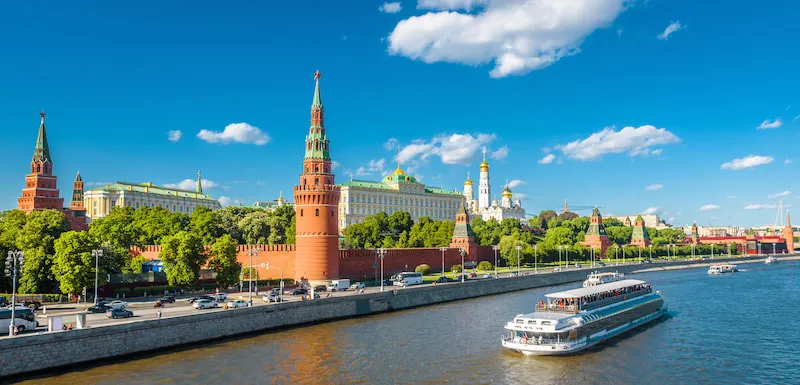
The journey along the Golden Ring begins in Moscow We will see the main sights of the capital, walk along Tverskaya, Teatralnaya, and Manezhnaya Squares, visit Red Square and Alexander Garden, and enter the territory of the ancient Kremlin. We will finish the day in Zaryadye Park, enjoying views from the “Floating Bridge” and exploring plants gathered from different climatic zones of Russia.
Weather in Moscow
+16°C/+61°F
22.09.2026

rain
Humidity
65%
Wind
3 km/h
High
+17°C/+63°F
Low
+13°C/+55°F
Monument to Yuri Dolgorukiy in Moscow
The monument to the founder of the city has long been a symbol of Moscow. It was installed in 1954, for the 800th anniversary of the city. Yuri Dolgorukiy was the Prince of Rostov and Suzdal. The first mention of Moscow in the chronicle in 1147 coincides with the period of his rule. The prince is depicted mounted on horseback. Like a hero from epic tales, he extends his arm, pointing to the place where the city should be founded.
Address: 55.761790, 37.610114
Tverskaya Street
We continue our walk along Tverskaya Street. It is located between two squares—Manezhnaya and Triumfalnaya. Its length is 1.6 km. Here are well-known Moscow landmarks: the monument to Pushkin, the Central Telegraph building, the National Hotel, the former English Club, and many other interesting sites to explore.
Address: 55.763903, 37.606478
Teatralnaya Square
A must-visit place. This is where Moscow’s famous theaters are located—the Bolshoi, the Russian Academic Youth Theater (RAMT), and the Maly Theater, near which stands a monument to Alexander Ostrovsky. The square in front of the Bolshoi Theatre is decorated with the Vitali Fountain of 1835—the oldest functioning fountain in Moscow. In winter, the square is adorned with New Year installations. At any time of the year, this place is perfect for a photoshoot—be sure to take a photo to remember your trip!
Address: 55.758559, 37.619342
Manezhnaya Square
One of the central squares of Moscow. The square is located next to the Kremlin, Alexander Garden, and Mokhovaya Street. The Historical Museum and the Manege building adjoin it. In front of the Historical Museum stands an equestrian statue of Marshal Zhukov. He went down in history as the “Marshal of Victory” for his decisive contribution to the triumph in the Great Patriotic War. Near the Resurrection Gate of Kitay-gorod is the “Zero Kilometer” mark — a special point from which road distances in Russia are measured. This is also where the pedestrian route “Road to the Lavra” begins. Manezhnaya Square is one of the main locations for festivals and city celebrations, such as “Journey into Christmas.”
Address: 55.755763, 37.614680
Alexander Garden
A garden by the Kremlin walls. The garden was created under Alexander I and named after him. Previously, the Neglinnaya River flowed here, but it was placed underground during the reconstruction of Moscow after the fire of 1812, performed under the direction of architect Osip Bove by imperial order. The main features of Alexander Garden are the Eternal Flame and the Tomb of the Unknown Soldier, where the Honor Guard is changed every hour from 8:00 am to 8:00 pm at Post No. 1. A monument to Alexander I stands in the center of the garden. There is also a museum pavilion where tickets to the Kremlin — to Cathedral Square and the Armoury Chamber — are sold.
Address: 55.752084, 37.613567
The Moscow Kremlin
The oldest part of the city. The Kremlin is a UNESCO World Heritage Site. The history of Moscow began with the Kremlin. Many cities have a kremlin, but the Moscow one is unique. Inside are ancient cathedrals where Russian tsars were crowned and laid to rest. In the Armoury Chamber are treasures of the royal treasury: ceremonial clothing and armor, tableware, and works of Russian and Western European craftsmen. The Kremlin walls are decorated with battlements called “swallowtails” — this architectural element came from Italy and has long since become a symbol of Moscow. The most famous Kremlin tower is the Spasskaya Tower. Under the chimes of its clock, Russia welcomes every New Year. Entrance to the Kremlin grounds is through Kutafya Tower and the Trinity Bridge.
Address: Coordinates: 55.752004, 37.617734
Website: kreml.ru
Assumption Cathedral in the Moscow Kremlin
The first stone cathedral of the Moscow Kremlin. It was built in the 15th century. Here, Russian rulers were crowned — from the Rurik dynasty to the Romanovs — patriarchs were enthroned, and the most important state decrees were proclaimed.
Address: 55.750922, 37.617011
Archangel Cathedral
The burial vault of Moscow princes and tsars. Archangel Cathedral was built between 1505 and 1508 by architect Aloisio the New. Buried here are rulers of the ancient Rurik dynasty: Dmitry Donskoy, Ivan Kalita, Ivan III, Vasily III, Ivan the Terrible and his sons, including Tsarevich Dmitry, who died in childhood in Uglich and was canonized as a saint.
Address: 55.750180, 37.617702
Annunciation Cathedral
The house church of Russian grand princes and tsars. The cathedral was built by Pskov architects between 1484 and 1489. Ancient frescoes have been preserved inside, and the iconostasis features works by Theophanes the Greek and Andrei Rublev — great masters of icon painting.
Address: 55.749959, 37.616977
Tsar Bell and Tsar Cannon
Symbols of Russia. The bell was cast in 1734–1735 during the reign of Empress Anna Ioannovna. It is considered the largest bell in the world. The bell’s height is more than 6 meters, the wall thickness is 61 cm, and its weight is over 200 tons. The Tsar Cannon is an outstanding piece of foundry art and one of the largest cannons in the world. It was cast from bronze in 1586 by master Andrey Chokhov at the Moscow Cannon Yard.
Address: 55.750823, 37.618390 and 55.751454, 37.617945
Red Square
The most famous landmark and the very heart of Moscow. The architectural ensemble of Red Square took shape over centuries. The Kremlin, St. Basil's Cathedral, the State Historical Museum, GUM department store, and Lenin's Mausoleum – each building stands as a monument to its era, together creating the unique appearance of the capital's center. Here you'll also find the Zero Kilometer Marker, symbolizing the starting point for measuring distances on all roads radiating from Moscow.
Website: kreml.ru
Zaryadye Park
A modern landscape park. Its territory includes a concert hall, an exhibition space, and an underground museum. In the “Florarium” greenhouse, you can take the shortest journey across Russia and see plants from all regions of the country. One of the most famous attractions is the “Floating Bridge” over the Moskva River. From it you can see the Kremlin towers, the Cathedral of Christ the Savior, the Kotelnicheskaya Embankment skyscraper, and other landmarks. On the park grounds, the Old English Court of the early 16th century has been preserved and now houses a museum. You can also ascend the restored section of the Kitay-gorod wall, visit the attraction “Flight Over Moscow 2.0” in the Media Center, and see the city from a bird’s-eye view.
Address: 6 Varvarka Street, Building 1, Moscow
Website: zaryadyepark.ru
Day 2. Moscow
On the second day, we continue exploring Moscow. We will immerse ourselves in the cultural life of the capital, see the Bolshoi and Maly Theatres, the Moscow skyscrapers and towers of Moscow City, visit the largest Orthodox cathedral in Russia, enjoy panoramic views from Sparrow Hills, and finish the day at Victory Park on Poklonnaya Hill.
Weather in Moscow
+16°C/+61°F
22.09.2026
rain
Humidity
65%
Wind
3 km/h
High
+17°C/+63°F
Low
+13°C/+55°F
Bolshoi Theatre
A symbol of Russian ballet and opera. The theatre is world-famous for its productions. The building in which the theatre is located today was constructed in the 19th century. Before that, there were four buildings, all destroyed by fire. The architect of the major reconstruction was Albert Kavos, who restored the theatre after the fire in 1836–1838 based on a design by Osip Bove. The Apollo quadriga on the façade was created by sculptor Peter Clodt. On the Bolshoi stage, Feodor Chaliapin, Sergei Lemeshev, and Galina Vishnevskaya performed, and ballet legends Galina Ulanova, Maya Plisetskaya, and Maris Liepa shone. The building is also known for being the site where, in December 1922, the Treaty on the Formation of the Union of Soviet Socialist Republics was signed.
Address: 1 Teatralnaya Square, Moscow
Website: bolshoi.ru
Maly Theatre
One of the oldest theatres in Russia. In 2024, it celebrated its 200th anniversary. The theatre building was completed in 1824 by architects Osip Bove and Andrei Mikhailov. The first performance was staged here on October 26, 1824. Maria Yermolova, Mikhail Shchepkin, and other performers appeared on its stage. This theatre is the keeper of Russian classical theatre traditions. Here you can see productions based on works by Pushkin, Griboedov, Gogol, Ostrovsky, and other Russian writers and playwrights.
Address: 1 Teatralny Proyezd, Moscow
Website: maly.ru
Manege
Central exhibition hall. The Manege building was constructed in 1817 by architect Agustín de Betancourt in honor of the victory in the War of 1812. Emperor Alexander I attended its opening ceremony. Later, Osip Bove decorated the façade with Empire-style elements. The Manege houses the Central Exhibition Hall, where art exhibitions, forums, festivals, and cultural events take place.
Address: 1 Manezhnaya Square, Moscow
Moskvoretskaya Embankment
A beautiful view of the Kremlin. The embankment stretches between the Bolshoy Moskvoretsky and Bolshoy Ustinsky bridges. From here, you can enjoy a stunning view of the Kremlin, St. Basil’s Cathedral, and the Kotelnicheskaya Embankment skyscraper. Part of the embankment runs beneath the “Floating Bridge” in Zaryadye Park. Near the bridge, deeper inside the park, stands the small Church of the Conception of Saint Anne, built in the second half of the 16th century — one of the oldest functioning churches in Moscow.
Address: 55.749511, 37.632520
Main Building of Moscow State University on Sparrow Hills
A Stalinist skyscraper. Seven skyscrapers became the architectural symbol of post-war Moscow, built from 1947 to 1957 for the 800th anniversary of the city. The tallest of them is the main building of Moscow State University on Sparrow Hills: with the spire, its height reaches 236 meters, and it was completed in 1953. The central façade is decorated with a 9-meter diameter clock, and a 12-ton five-pointed star stands atop the spire.
Address: 1 Leninskie Gory Street, Moscow
Kotelnicheskaya Embankment Skyscraper
A residential building. Built in 1952. Famous Soviet figures lived here: ballerina Galina Ulanova, singer Lyudmila Zykina, actress Faina Ranevskaya, writer Konstantin Paustovsky, and others. The skyscraper is an open-air museum — decorated with bas-reliefs and commemorative plaques bearing the names of its prominent residents. The memorial museum of Galina Ulanova and the cinema “Illuzion,” which screens rare archival films from the State Film Fund’s collection, operate here.
Address: 1/15B Kotelnicheskaya Embankment, Moscow
Ministry of Foreign Affairs Building
A 172-meter-tall skyscraper near Arbat Street. It was built in 1953 and is the only Moscow skyscraper without a star on its spire. Initially, a spire was not planned — a different architectural design was considered. However, it was added later as a decorative structure painted to match the building. According to legend, Stalin personally insisted that the spire be added. The façade of the central section is adorned with the coat of arms of the USSR.
Address: 32–34 Smolenskaya-Sennaya Square, Moscow
Kudrinskaya Square Skyscraper
The aviators’ house. Residents included aviation industry specialists — aircraft designers, pilots, and cosmonauts. The building was designed by Mikhail Posokhin, the chief architect of Moscow from 1960 to 1981. In Soviet times, the largest grocery store in Moscow operated on the first floor, decorated with stained glass by Pavel Korin.
Address: 1 Kudrinskaya Square, Moscow
Cathedral of Christ the Saviour
A symbol of Russia’s spiritual revival. It was built on the site of the original cathedral by Konstantin Thon, which was demolished in 1931. During Soviet times, the Grand Palace of the Soviets (another Stalinist skyscraper) was planned here, but the project was never realized. Later, an open-air swimming pool operated on this site from 1960 to 1994. The cathedral was rebuilt according to historical drawings, using modern materials, and reopened in 2000. It is now the main cathedral of the country, where holiday services are broadcast from. You can visit independently or with a guided tour, and also go up to the observation deck overlooking the historic center.
Address: 15 Volkhonka Street, Moscow
Website: xxc.ru
Moscow City
A modern business district with skyscrapers and futuristic architecture. The OKO and Federation Towers have observation decks: “Above Only Love” at 354 meters and “Panorama 360°” at 327 meters. The deck on OKO Tower is considered the highest open observation platform in Europe. With a ticket to the Federation Tower deck, you can also visit the Chistaya Liniya ice cream factory and try a signature dessert.
Address: Coordinates: 55.749443, 37.542813
Observation Deck on Sparrow Hills
One of the best viewpoints of the capital. The view includes the Kremlin, the Moskva River, Luzhniki Stadium, Moscow City towers, and Novodevichy Convent. Next to the viewing point is a cable car that connects two banks of the Moskva River. Its lower station is located near Luzhniki Stadium.
Address: Kosygina Street at the intersection with Universitetskaya Square, Moscow
Poklonnaya Hill
A memorial complex. The complex is dedicated to the victory of the Soviet people in the Great Patriotic War. Victory Park opened on May 9, 1995. Here stands the Museum of Victory with one of the largest military-historical exhibitions in the world, and on Poklonnaya Hill rises the tallest monument in Russia. This is the Victory Monument by sculptor Zurab Tsereteli, with a height of 141.8 meters. The monument resembles the bayonet of a Mosin rifle, which Soviet soldiers carried into battle.
Address: Victory Square, Moscow
Day 3. Vladimir
On the third day of the trip, we head to Vladimir — one of the oldest cities of Ancient Rus. Here, outstanding examples of white-stone architecture have been preserved, along with frescoes by Andrei Rublev, and from the city hills there are scenic views of the Klyazma River valley. We begin the walk at the Golden Gate — the ceremonial entrance to the ancient city, see the Assumption and Dmitrievsky Cathedrals, and explore Georgievskaya Street, where the atmosphere of old Vladimir has been preserved.
Weather in Vladimir
+14°C/+57°F
22.09.2026

cloudy
Humidity
72%
Wind
1.8 km/h
High
+23°C/+73°F
Low
+12°C/+54°F
Golden Gate
The symbol of Vladimir. The main ceremonial entrance to the city since the 12th century. The Golden Gate with the Gate Church of the Deposition of the Robe was built between 1158 and 1164. There were once seven gates in Vladimir performing defensive functions together with the fortress ramparts, but only the main ceremonial gate has survived. This monument of white-stone architecture is included in the cultural heritage list of Russia and UNESCO.
Address: 1A Bolshaya Moskovskaya Street, Vladimir
Georgievskaya Street
The main tourist street. This street is named after the 12th-century Church of St. George. After reconstruction in 2015, it became pedestrian. It is pleasant to stroll here, visiting souvenir and vintage shops, and admiring merchant houses and amusing sculptures. All the sculptures were created by one artist — local sculptor Igor Chernoglazov. On Georgievskaya Street you will find the fairy-tale museum “Babusia-Yagusia,” the Old Pharmacy from 1805 (now a museum), and the working Borodin Forge.
Address: Coordinates: 56.126413, 40.401299
Assumption Cathedral in Vladimir
A UNESCO site. One of the few surviving monuments of white-stone architecture of Vladimir-Suzdal Rus. The cathedral was built in 1158–1160 during the reign of Prince Andrei Bogolyubsky. It served as the prototype for the Assumption Cathedral of the Moscow Kremlin. Today the cathedral operates as both a museum and an active church. Inside, frescoes by Andrei Rublev and Daniil Cherny have been preserved — more than 300 m² of wall paintings.
Opening hours: Monday–Saturday 10:00 am-5:00 pm,
Sunday 11:00 am-5:00 pm
Address: 56 Bolshaya Moskovskaya Street, Vladimir
Website: vladmuseum.ru
Assumption Cathedral in Vladimir
A UNESCO site. One of the few surviving monuments of white-stone architecture of Vladimir-Suzdal Rus. The cathedral was built in 1158–1160 during the reign of Prince Andrei Bogolyubsky. It served as the prototype for the Assumption Cathedral of the Moscow Kremlin. Today the cathedral operates as both a museum and an active church. Inside, frescoes by Andrei Rublev and Daniil Cherny have been preserved — more than 300 m² of wall paintings.
Opening hours: Monday–Saturday 10:00 am-5:00 pm,
Sunday 11:00 am-5:00 pm
Address: 56 Bolshaya Moskovskaya Street, Vladimir
Website: vladmuseum.ru
Dmitrievsky Cathedral
The palace church of Prince Vsevolod the Big Nest. Next to the Assumption Cathedral stands another masterpiece of pre-Mongol architecture — the Dmitrievsky Cathedral. It was built in the 1190s. The façades are decorated with rich stone carvings — more than 600 reliefs depicting Biblical King David: griffins, centaurs, lions, and mythical birds. The cathedral functions as a museum; religious services are not held here.
Opening hours: Thursday–Friday, Sunday–Tuesday 10:00 am-6:00 pm;
Saturday 11:00 am-7:00 pm;
Wednesday closed
Address: 60 Bolshaya Moskovskaya Street, Vladimir
Website: vladmuseum.ru
Day 4. Suzdal — Ivanovo
On the fourth day of the route we will continue exploring two cities of the Golden Ring — Suzdal and Ivanovo. We will start with Suzdal, which is often called an open-air museum. We will visit the Pokrovsky Convent, the Suzdal Kremlin, the Spaso-Evfimiev Monastery, and the Museum of Wooden Architecture. There we will see ancient buildings collected from surrounding villages, learn about local gastronomic traditions — we will try Suzdal mead and the famous cucumbers, from which they even make jam here. After that, we will head to Ivanovo — the symbol of factory culture and Constructivist architecture.
Weather in Suzdal
+13°C/+55°F
22.09.2026
cloudy
Humidity
75%
Wind
1.7 km/h
High
+23°C/+73°F
Low
+12°C/+54°F
Pokrovsky Women’s Monastery
The convent was founded in 1364 by Prince Andrey Konstantinovich of Suzdal. This is an ancient women’s monastery where the relics of Saint Sophia of Suzdal (in the world — Solomonia Saburova) are kept. She was the first wife of Grand Prince Vasily III, who ordered her to be tonsured as a nun and sent to this convent. The convent is known as a place of exile for disliked royal wives — tsarinas and princesses. In addition to Solomonia, exiled here were: the first wife of Peter I — Evdokiya Lopukhina, the fifth wife of Ivan the Terrible — Anna Vasilchikova, and the daughter of Boris Godunov — Ksenia. Today the convent houses a museum dedicated to its history.
Address: 76, Pokrovskaya St., Suzdal, Vladimir region
Website: spokrovmon.ru
Suzdal Kremlin
A historic monument of the 11th–13th centuries. The Kremlin in Suzdal appeared at the turn of the 10th–11th centuries. Only the defensive ramparts have survived to this day. Today on the territory of the Kremlin you can see the Cathedral of the Nativity of the Virgin with 13th-century frescoes and the Bishops’ Chambers, which house museum exhibitions.
Opening hours: Sunday–Friday 10 am-6 pm, Saturday 10 am-7 pm
Address: 20, Kremlevskaya St., Suzdal, Vladimir region
Website: vladmuseum.ru
Spaso-Evfimiev Monastery
The monastery on the bank of the Kamenka River was founded in 1352. Its first abbot was St. Euthymius of Suzdal. Today it is a UNESCO World Heritage site with museum-reserve status. The main cathedral of the monastery is the Transfiguration Cathedral, built in the 16th century. Inside, frescoes from 1689 have been preserved, created by the artel of the Yaroslavl master Gury Nikitin. On the belfry there are 17 pre-revolutionary bells, each with its own unique timbre. Bell concerts take place at the beginning of every hour and last about five minutes. Also, performances of the monastery male choir are held here.
Opening hours: Tuesday–Friday, Sunday 10 am-6 pm, Saturday 10 am-7 pm. Monday — closed
Address: 135, Lenina St., Suzdal, Vladimir region
Website: vladmuseum.ru
Museum of Wooden Architecture
Travel back in time. Here are assembled wooden architecture monuments from all over the Vladimir region: peasant houses, windmills, farm buildings, and churches of the 17th–19th centuries. Many buildings are open for entry. Among the most impressive: the multi-tiered Church of the Transfiguration (1756) and the Resurrection Church (1776), built in the traditional “ship” composition, where all volumes are lined up strictly along one axis. The Museum of Wooden Architecture hosts the Cucumber Day — the most famous holiday in Suzdal, celebrated in July.
Opening hours: Monday–Tuesday, Thursday–Friday, Sunday 10 am-6 pm, Saturday 10 am-7 pm. Wednesday — closed
Address: 27, Pushkarskaya St., Suzdal, Vladimir region
Website: vladmuseum.ru
Ivanovo Railway Station
Ivanovo Constructivism. The railway station building was constructed in 1933, designed by architect Kaverinsky. After the 2020 renovation, the Ivanovo station regained its historical appearance. The interior of the station is arranged as a historical reconstruction of the 1930s: two ceremonial halls — the Blue and the Red halls — were restored, and original mosaics, bas-reliefs, and Metlakh floor tiles were preserved. One of the symbolic elements of the interior is a stylized weaving loom — a reminder of the important role the textile industry played in the city’s history.
Address: 3, Vokzalnaya Sq., Ivanovo
Monument to Yakov Garelin
The monument was installed in 2011 in a city square. Yakov Garelin was an industrialist, philanthropist and the city head. He made a significant contribution to the development of Ivanovo as the center of the textile industry.
Address: Yakov Garelin Square, Ivanovo
Shudrov Chamber
The oldest brick building in Ivanovo. The building was constructed at the end of the 17th century, back when the city was still a village. It housed the office of the local rural clerk, where paperwork was conducted and petitioners were received. In the 19th century the building was purchased by merchant Osip Shudrov. Today it is part of the D.G. Burylin Museum of Industry and Art.
Address: 36A, 10 Avgusta St., Ivanovo
Museum of Ivanovo Chintz
Here you will learn the secrets of producing the famous Ivanovo chintz. The museum is located in the mansion of Dmitry Burylin, built in Art Nouveau style in the early 20th century. Here you can explore the history of textile production and learn more about the city’s main symbol — Ivanovo chintz. The museum features 19th-century looms, fabric samples and collections of folk costumes. A separate exhibition is dedicated to fashion designer Vyacheslav Zaitsev, who was born in Ivanovo. The museum is connected by an underground passage to the neighboring building — the Museum of Industry and Art. In 2025 the exhibitions are closed due to restoration.
Address: 11/42, Baturina St., Ivanovo
Website: igikm.ru
D.G. Burylin Museum of Industry and Art
One of the largest regional museums in Russia. Many call it “the Hermitage of Ivanovo.” It was founded by Dmitry Burylin — an industrialist and philanthropist who lived in the 19th — early 20th centuries. The collections cover the period from antiquity to the early 20th century. There are extremely rare exhibits on display, including one of the first printed books of the 15th century and a microscopic coin the size of an insect from the time of Peter the Great, created as a demonstration of the highest level of minting craftsmanship. You will also see a ceremonial saber and a robe inlaid with numerous precious stones, as well as the death mask of Peter the Great. Another unique exhibit is the astronomical clock with 95 dials — each one displays a separate indicator: time, phases of the Moon, movement of the planets, calendar dates and other astronomical data.
Opening hours: Tuesday–Sunday 10 am-6 pm
Monday and the last Friday of each month — closed
Address: 6/40, Baturina St., Ivanovo
Website: igikm.ru
Day 5. Yaroslavl — Kostroma
The fifth day will be dedicated to exploring the heritage of two Volga cities: Yaroslavl and Kostroma. The historical center of Yaroslavl is included in the UNESCO World Heritage List and preserves the spirit of Ancient Rus. We will take a walk along the embankment, see the confluence of the Volga and the Kotorosl rivers, admire magnificent cathedrals, and visit the territory of the former Spaso-Preobrazhensky Monastery. On the same day we will head to the ancient city of Kostroma — the center of jewelry art and a major port on the Volga. We will visit the Ipatiev Monastery, from where the first Romanov tsar was called to the throne, and Susanin Square — the “heart” of the city. We will see the main symbol of Kostroma — the Fire Tower, and go up to Ostrovsky’s Pavilion, which offers a beautiful panoramic view of the Volga and the city.
Weather in Yaroslavl
+21°C/+70°F
22.09.2026
cloudy
Humidity
53%
Wind
3 km/h
High
+22°C/+72°F
Low
+12°C/+54°F
Strelka
The place where the Volga and Kotorosl rivers meet, as well as a river spit. Here is Strelka Park, a 20-meter monument “1000 Years of Yaroslavl” with a figure of the city founder Prince Yaroslav the Wise, flowerbeds and fountains. The park is one of the most iconic symbols of the city. It is believed: if you haven’t been to Strelka — you haven’t seen Yaroslavl.
Address: Coordinates: 57.618602, 39.904629
Volga Embankment
A scenic promenade with river views. The embankment stretches for about 3 km and has two levels — upper and lower. Below there are pedestrian and bike paths, as well as the beautiful river station building. Walking along the upper level, you can admire architectural monuments and old buildings. Here are located the Metropolitans’ Chambers, the Art Museum and other landmarks.
Address: 57.633233, 39.892825
Assumption Cathedral
The main and largest cathedral of Yaroslavl. It was built in 2010 on the site of the historical Assumption Cathedral demolished in 1937. The rebuilt cathedral became a symbol of the city’s spiritual revival. Nearby stands the sculpture “Holy Trinity,” reminiscent of the famous icon by Andrei Rublev.
Address: 2/1, Kotoroslnaya Emb., Yaroslavl
Website: yar-uspenie.cerkov.ru
Church of Elijah the Prophet
A mid-17th century church in the center of Sovetskaya Square. Go inside to see gilded carved wooden décor and brightly colored 17th-century frescoes from floor to ceiling. The church belongs to the Yaroslavl Museum-Reserve, and entrance is paid. You can visit the interior only during the warm season — from May to October.
Address: 7, Sovetskaya Sq., Yaroslavl
Website: yarkremlin.ru
Church of Archangel Michael
Garrison church. It was built in honor of the defender and heavenly patron of the city. One of the oldest churches in Yaroslavl — built in 1682, belonging to the Yaroslavl architectural school. The church has two floors: the lower one is heated and services are held year-round; the upper one is summer and is currently under restoration. Previously, it housed the miraculous icon of Archangel Michael, presumably painted in 1300. Today it is in the Tretyakov Gallery in Moscow.
Address: 67, Pervomaiskaya St., Yaroslavl
Website: arhangela.cerkov.ru
Chapel of the Kazan Icon of the Mother of God
A snow-white Kazan chapel with stained-glass panels. The chapel stands on the Kotorosl River embankment, next to the Spaso-Preobrazhensky Monastery. It was built in 1997. The image of this chapel is on the 1000-ruble banknote.
Address: "Podzelenye" Park, Kotoroslnaya Emb., Yaroslavl
Epiphany Church
A red brick church with black domes. One of the main sights of the city and a monument of late 17th-century architecture. Its façade is decorated with multicolored ceramic tiles, and inside the rich interior, frescoes and 17th-century iconostasis have been preserved. The church is part of the Yaroslavl Museum-Reserve. You can visit it with a guided tour, and during services — enter for free.
Address: 12, Bogoyavlenskaya Sq., Yaroslavl
Website: yarkremlin.ru
Monument to Yaroslav the Wise
A monument to the Prince — the founder of the city. The monument stands in the center of Bogoyavlenskaya Square. It was installed in 1993 according to the design of sculptor Oleg Komov. Saint Prince Yaroslav the Wise is depicted standing full-height: one hand rests on a sharp sword, and the other holds a model of the city.
Address: Bogoyavlenskaya Sq., Yaroslavl
Fyodor Volkov Drama Theatre
The first professional theater in Russia. The theater opened in 1750. It was founded by Fyodor Volkov — the son of a Kostroma merchant, an actor and theatrical figure. The repertoire includes classical plays and productions by contemporary playwrights. The building in which the theater is now located was built in 1911. Here you can not only watch performances, but also take tours, where you can learn the history of the theater and see behind the scenes.
Address: 1, Volkov Sq., Yaroslavl
Website: volkovteatr.ru
Spaso-Preobrazhensky Monastery
The white-stone fortress walls with embrasures have been preserved here. Today the monastery territory houses the Yaroslavl Museum-Reserve. Its exhibitions tell the history of the city. Here stands the Transfiguration Cathedral, built during the reign of Prince Vasily III — the oldest church in Yaroslavl. It is famous as the place where at the end of the 18th century the ancient epic “The Tale of Igor’s Campaign” was discovered. A separate exhibition in the museum is dedicated to this event. Inside, 16th-century frescoes have been preserved. They can be seen during the warm season. The architectural ensemble of the monastery is a UNESCO World Cultural Heritage site. If desired and if time allows, you can also visit a very unusual museum — the “Golden Ring Show-Model” with interactive miniature cities enhanced with light and sound effects. After exploring Yaroslavl, we head to Kostroma — the cheese capital, the center of jewelry art and the “cradle of the Romanov royal dynasty.”
Opening hours: Sunday–Friday 9 am-6 pm, Saturday 9 am-9 pm
Address: 25, Bogoyavlenskaya Sq., Yaroslavl
Website: yarkremlin.ru
Ipatiev Women’s Monastery
An active convent with a strict monastic rule. The Ipatiev Monastery is known for the fact that in 1613 the first tsar of the Romanov dynasty — Mikhail — was called to the throne from here. The chambers of the Romanov boyars have been preserved on the monastery grounds, and a museum introduces visitors to its history. The main church of the monastery is the 17th-century Trinity Cathedral, where ancient frescoes and a gilded iconostasis have been preserved.
Address: 1, Prosveshcheniya St., Kostroma
Website: ipatievsky-monastery.ru
Monument to Lenin
An unusual monument in the Central Park. The monument to V.I. Lenin was installed in 1928 on a pedestal that was originally made for a monument commemorating the 300th anniversary of the Romanov dynasty. If you look closely, the contrast between the statue of Lenin and the royal pedestal becomes very obvious.
Address: Central Park, Kostroma
Trading Arcades
Feel the merchant atmosphere of Kostroma. Head to the Trading Arcades — an architectural monument of the 18th–19th centuries. These are merchant stalls joined by a covered gallery, located next to Susanin Square. The oldest of them are the Flour Arcades. Later came the Red, Tobacco, Kvass, Gingerbread and others. Even today, active trade continues here. They sell Kostroma cheese, linen clothing, jewelry and artisan souvenirs.
Monument to Ivan Susanin
A hero of the struggle against the Polish intervention of the 17th century. Susanin saved the life of the young Mikhail Romanov, the future tsar. The monument was installed in 1967 to replace the one demolished after the revolution. Today it is one of the main symbols of Kostroma.
Address: Susanin Square Park, Kostroma
Susanin Square
Locals call this square “the frying pan” because of its round shape. The square has streets diverging from it like rays. It is located next to the monument to Susanin. In the center stands a memorial sign. Nearby there is a monument to a heroic dog — “Firefighter Bobka.” The monument is dedicated to a dog who lived in a local fire station at the end of the 19th century. He was an essential part of the fire brigade and always accompanied them on calls, helping to pull people and belongings out of burning buildings.
Address: Coordinates: 57.768072, 40.927155
Fire Tower
One of the most beautiful in Russia. The Kostroma Fire Tower is located in the city center and is a UNESCO protected site. It was built in the early 19th century in the late Classicism style. Previously, it housed the fire department, residential rooms for employees, garages, and on the observation deck a watchman was on duty. In the evenings, the tower is beautifully illuminated. Inside, there is an interactive exhibition “Archaeological Portal.”
Address: 1/2, Simanovsky St., Kostroma
Website: kosmuseum.ru
Guardhouse Building
An impressive Classical-style building with columns. Opposite the fire tower stands the former guardhouse. Both buildings were constructed approximately at the same time based on the design of local architect Fursov. Previously, the guardhouse contained detainees, and now it houses the exhibition of the Military-Historical Museum.
Address: 1/2, Lenin St., Kostroma
Website: kosmuseum.ru
Borshchov House
A beautiful example of provincial Classicism. The mansion was built in 1824. It once belonged to Senator and Lieutenant General Borshchov. Emperor Nicholas I stayed in this house with his son, the future Emperor Alexander II, and their tutor — the poet Zhukovsky. Today the building houses the district court.
Address: 1, Shagova St., Kostroma
Monument to Yuri Dolgorukiy in Kostroma
Prince Yuri Dolgorukiy is considered the founder not only of Moscow, but also of Kostroma. The monument in his honor was installed in 2003 for the 850th anniversary of the city. Yuri Dolgorukiy is depicted with his arm extended forward, pointing to the place where the city would be founded.
Address: 3, Sovetskaya St., Kostroma
Botnikovsky Garden
The oldest city garden. The garden was founded in the 19th century. It is located across the street from the Trading Arcades, opposite the city administration building. At the corner of the garden stands a miniature sculpture of the Snow Maiden (Snegurochka). This fairy-tale character — a hardworking beauty, daughter of Spring and Frost — first appeared in a play by Russian writer Ostrovsky. Since the play was written on Kostroma land, this place is now considered the homeland of Snegurochka.
Address: Coordinates: 57.766934, 40.927952
Kostroma Kremlin
The place where the city was founded in the 12th century. The historical Kremlin of Kostroma has not survived. Now this place is occupied by the Central Park of Culture and Recreation. Here stands the Epiphany Cathedral, restored between 2015–2023. One of the most important Orthodox relics — the miracle-working Feodorovskaya Icon of the Mother of God — was transferred here.
Address: 10, Tchaikovsky St., Kostroma
Website: kostroma-kreml.ru
Ostrovsky Pavilion
The best observation point with a view of the Volga. The pavilion on the high bank of the Volga was built in 1956 and became widely recognized after one of the most beautiful scenes of the famous Soviet film based on Ostrovsky’s work — “Cruel Romance” — was filmed here. The film tells a dramatic love story of a beautiful young girl from a provincial town at the end of the 19th century. If you wish, you can also take a tasting tour at the Cheese Museum or take part in a jewelry workshop at the interactive “Golden Alley” in the Red Arcades.
Address: Coordinates: 57.761879, 40.928652
Cheese Museum
Cheese is one of the main gastronomic brands of Kostroma. The city dedicated an entire museum to it, where visitors are introduced to the history of Kostroma cheesemaking in an interactive format. Here you can take part in tasting local cheese varieties, learn production secrets, and purchase delicious souvenirs.
Address: 19, Tchaikovsky St., Kostroma
Website: музейсыра.com
Day 6. Yaroslavl
The sixth day of the trip is dedicated to Yaroslavl. We will stroll around the city, visit museums and souvenir shops, and taste traditional Volga cuisine. Optionally, you can visit the village of Vyatskoye, which is part of the Association of the Most Beautiful Villages of Russia, or travel to the ancient towns of Rybinsk and Uglich.
Weather in Yaroslavl
+21°C/+70°F
22.09.2026
cloudy
Humidity
53%
Wind
3 km/h
High
+22°C/+72°F
Low
+12°C/+54°F
"Music and Time" Museum
The museum was founded in 1993. Here you will find antique clocks, music boxes, gramophones, phonographs, bells, and small bells. Guided tours take place continuously — you can join at any time.
Opening hours: Monday–Sunday 10:00 am-7:00 pm
Address: 33A Volzhskaya Embankment, Yaroslavl
Website: музыкаивремя.рф
Yaroslavl Art Museum
The main art museum of the region. The museum is located in the former governor’s mansion, built as an imperial travel palace. It exhibits works by Bryullov, Levitsky, Repin, Perov, Shishkin, Levitan, and other Russian artists. In the governor’s garden, you can view a collection of contemporary sculptures.
Opening hours: Tuesday–Thursday, Sunday 10:00 am-6:00 pm, Friday–Saturday 10:00 am-9:00 pm, Monday closed
Address: 23 Volzhskaya Embankment, Yaroslavl
Website: yarartmuseum.ru
Museum of Foreign Art
A branch of the Art Museum. The collection contains more than 2,000 works of art from the 16th to early 20th centuries. You will see Dutch still lifes, Italian paintings, Japanese prints, Chinese porcelain, and Florentine furniture from the collection of V.P. Kochubey.
Opening hours: Tuesday–Sunday 10:00 am-6:00 pm, Monday closed
Address: 2 Sovetskaya Square, Yaroslavl
Website: yarartmuseum.ru
V.Y. Orlov Museum
It is dedicated to the director of the Yaroslavl Technical Carbon Plant. The museum is housed in a restored mansion from the early 19th century. It exhibits items from Orlov’s personal collection, which he began assembling in the 1980s: porcelain, cast-iron art, silver tableware, and decorative silver.
Opening hours: Wednesday–Monday 10:00 am-7:00 pm, Tuesday closed
Address: 15 Volzhskaya Embankment, Yaroslavl
Website: orlovmuseum.ru
Yaroslavl City History Museum
Located in the estate of merchant Kuznetsov from the late 19th century. The permanent exhibition “Ten Centuries of Yaroslavl” tells the story of the city. Here are exhibits related to archaeology, architecture, trade, crafts, culture, and everyday life.
Opening hours: Wednesday–Monday 10:00 am-7:00 pm, Tuesday closed
Address: 17/1 Volzhskaya Embankment, Yaroslavl
Website: mukmig.yaroslavl.ru
Metropolitan Chambers
A branch of the Yaroslavl Art Museum. The collection of ancient Russian art is housed in the Metropolitan Chambers, built in the 1680s on the territory of the Transfiguration Monastery. The museum contains icons from the 13th–17th centuries, including rare and ancient pieces, as well as icon painting by Yaroslavl masters.
Opening hours: Tuesday–Sunday 10:00 am-6:00 pm, Monday closed
Address: 1 Volzhskaya Embankment, Yaroslavl
Website: vk.com
Day 7. Rostov Veliky — Pereslavl-Zalessky — Sergiev Posad — Moscow
The final day of the Golden Ring journey We will travel to Rostov Veliky on the shores of Lake Nero, then to the homeland of Prince Alexander Nevsky — Pereslavl-Zalessky, visit the Holy Trinity Sergius Lavra in Sergiev Posad, and return to Moscow.
Weather in Rostov Veliky
+19°C/+66°F
22.09.2026
cloudy
Humidity
68%
Wind
2 km/h
High
+22°C/+72°F
Low
+11°C/+52°F
Rostov Veliky. Spaso-Yakovlevsky Dmitriev Monastery
A monastery on the shore of Lake Nero. It was founded by Saint Iakov, Bishop of Rostov, in 1389, and his relics rest here. This is an active men’s monastery with buildings from the 17th–19th centuries. Next to the church, there is a spring with holy water, believed to have healing properties. From the viewing platform on the tower, there is a picturesque view of the lake.
Address: Engelsa Street, Rostov Veliky, Yaroslavl Region
Website: rostov-monastir.ru
Rostov Veliky. Rostov Kremlin
An outstanding architectural monument of the 17th century. It was not built for defense, but as a residence for the Metropolitan of Rostov and Yaroslavl. The territory has the status of a museum reserve, and entrance is by ticket. Walk across Cathedral Square and along the ramparts overlooking Lake Nero, visit the ancient Assumption Cathedral and the Metropolitan Garden. In the belfry hangs a huge bell, “Sysoy,” cast in 1688 and weighing 32 tons. The Museum of Finift is also located here. It showcases the history of this ancient craft and offers workshops where visitors can create a souvenir with their own hands. We continue the journey to Pereslavl-Zalessky. We will see Lake Pleshcheyevo and a city full of small cozy museums.
Address: 8 Sobornaya Square, Rostov Veliky, Yaroslavl Region
Website: rostmuseum.ru
Pereslavl-Zalessky. Transfiguration Cathedral
The oldest white-stone church of Northeastern Rus, founded in 1152. It is located in the historic center of the city. During restoration, mythical creatures — a lion and a unicorn — were found engraved on the metal doors. The cathedral is open to visitors in the warm season.
Address: 1A Krasnaya Square, Pereslavl-Zalessky, Yaroslavl Region
Website: museumpereslavl.ru
Pereslavl-Zalessky. Monument to Alexander Nevsky
A monument to Prince Alexander Nevsky, the founder of the city In Soviet times, the cathedral housed the Alexander Nevsky Museum, which has now moved to Muzeiny Lane opposite the Goritsky Monastery.
Address: Krasnaya Square, Pereslavl-Zalessky, Yaroslavl Region
Pereslavl-Zalessky. Church of Alexander Nevsky
A mid-18th century church. Together with the nearby Vladimir Cathedral, it forms part of the architectural ensemble of Krasnaya Square. Both churches were built at the same time and share similar architectural features. The church was named in honor of Saint Alexander Nevsky. Inside, there is a reliquary with a fragment of his holy relics.
Address: Stary Gorod, Pereslavl-Zalessky, Yaroslavl Region
Pereslavl-Zalessky. “Botik of Peter I” Museum
Discover the history of Peter the Great’s “toy fleet”. Opened in 1803, the museum is located on a high hill near Lake Pleshcheyevo. It was here that young Peter, the future emperor, built his first shipyard in the late 17th century, and in 1692 the first ships were launched. He used these vessels to study maritime skills. The museum exhibits the historical boat “Fortuna,” the only surviving vessel from the toy fleet. The final stop of the route is Sergiev Posad — a city founded by Saint Sergius of Radonezh.
Address: Botik settlement, Pereslavl-Zalessky Urban District, Yaroslavl Region
Website: museumpereslavl.ru
Sergiev Posad. Holy Trinity Sergius Lavra
The main shrine of Orthodox Russia. It was founded by Saint Sergius of Radonezh in the 14th century, and later the city grew around it. This is a unique architectural monument and an active men’s stauropegial monastery, the largest in Russia, where many Orthodox relics are kept. The main shrine is the relics of Sergius of Radonezh, resting in the reliquary of the Trinity Cathedral. You can explore the Lavra on your own, but it is better to take a guided tour from the pilgrimage center.
Address: Coordinates: 56.311120, 38.130492
Website: lavra.ru
Sergiev Posad. Trinity Cathedral
The oldest church of the Lavra. Construction was completed in 1423. It is the first stone church of the monastery, built of white stone in the early Moscow style. In the southern part of the cathedral, next to the altar, lie the relics of Sergius of Radonezh. The frescoes were created by icon painters Andrei Rublev and Daniil Cherny. In June 2024, the famous icon “Trinity” by Andrei Rublev, previously kept in the Tretyakov Gallery, was returned here.
Address: Coordinates: 56.309735, 38.129468
Sergiev Posad. Assumption Cathedral
Built in 1585. The cathedral was constructed during the reign of Ivan the Terrible, in the early Moscow architectural style. It is easily recognized by its blue domes with stars. The church was modeled after the Assumption Cathedral of the Moscow Kremlin. Go inside to see 17th-century frescoes and ancient royal gates painted by Simon Ushakov. The cathedral houses the relics of Saint Innocent of Moscow and Maximus the Greek.
Address: Coordinates: 56.310375, 38.130636
Sergiev Posad. Refectory Church and Church of the Descent of the Holy Spirit
Beauty in every detail. The Refectory Church was built for the 300th anniversary of the discovery of the relics of Saint Sergius of Radonezh. It was constructed later than the others — at the end of the 17th century, and features Baroque architectural elements, decorated columns, and intricate stucco. Originally, it was intended for festive feasts and receptions for members of the royal family. Inside, beautiful murals and stucco have been preserved. The church resembles a palace with a ceremonial staircase and an open terrace. The Church of the Descent of the Holy Spirit is one of the oldest buildings of the Lavra. It was built in 1476–1477 by masters from Pskov in the austere style of Novgorod-Pskov architecture. Its uniqueness lies in the fact that it is combined with a belfry — the bells hang directly under the dome.
Address: Coordinates: 56.309505, 38.130387 and 56.309946, 38.130167
Website: lavra.ru
Sergiev Posad. Observation Deck on Blinnaya Hill
The best view of the Lavra. Telescopes are installed here, allowing you to observe the Lavra in detail. This is also a great spot for panoramic photographs.
Address: Coordinates: 56.307319, 38.134993
Sergiev Posad. Sofi Gingerbread Workshop
The largest gingerbread model of the Trinity Sergius Lavra in Russia. A museum and gingerbread workshop where you can see “Pushkin’s gingerbread fairy tales” and tools — boards and other devices used to make traditional gingerbread. Workshops are held here, where visitors can create and decorate printed gingerbread and gingerbread houses. There is also a café where you can taste delicious gingerbread and other desserts.
Opening hours: Monday–Sunday 10:00 am-8:00 pm
Address: 25/10 Voznesenskaya Street, Sergiev Posad, Moscow Region
Website: пряничнаямастерская.рф