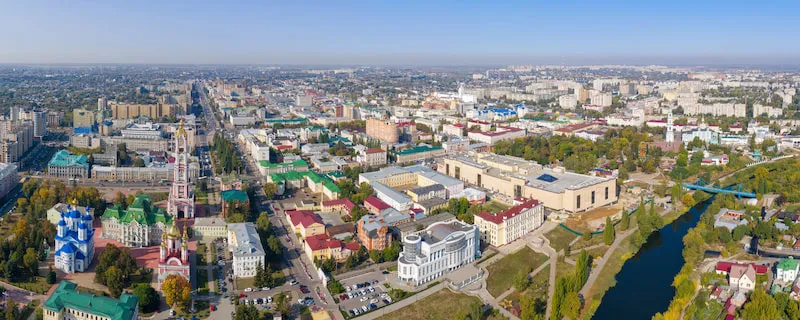
Day 1. Obninsk
Obninsk is the city where the first atomic reactor was created — the one that harnessed nuclear energy for peaceful purposes and launched the development of civilian nuclear power worldwide.
Weather in Obninsk
+8°C/+46°F
15.09.2026

cloudy
Humidity
91%
Wind
0.8 km/h
High
+19°C/+66°F
Low
+8°C/+46°F
Turliki Estate (Morozov’s Dacha)
The oldest building in Obninsk The mansion was built in the late 19th century by landowner Obninsky — a scholar and philanthropist of Polish origin who received the estate as part of his wife’s dowry. It came to be known as “Morozov’s Dacha” after it was purchased by the widow of Savva Morozov. The building was constructed with the most advanced technologies of its time. Beneath the two-story house lies a basement level with a kitchen and service rooms. Prepared dishes were lifted upstairs by a mechanical elevator. The house had central heating and hot water. There was also an observatory, and the estate welcomed guests such as artists Levitan, Serov, and Polenov, and poets Bryusov, Bely, and others. After 1918, a children’s colony called “Brisk Life” was established here — essentially an early form of a summer camp. During the Great Patriotic War, it hosted the Headquarters of the Western Front. G. K. Zhukov, I. S. Konev, and V. D. Sokolovsky all worked here. From 1946 the building belonged to “Laboratory V,” where classified scientific research was conducted. Today it is part of the Obninsk City History Museum. Tours of the estate take place on Saturdays and begin at 12:00 pm. To join a tour, you must purchase a ticket at the museum’s ticket office (128 Lenina Avenue, Obninsk) or pay in cash on-site before the tour begins.
Address: 1 Pirogova St., Nizhny Park
Physics and Power Engineering Institute
The world’s first atomic power plant The plant was built in 1954. It was developed in the secret “Laboratory V” of the Physics and Power Engineering Institute. The plant is now decommissioned, and the Museum of Atomic Energy has been established on its grounds. Only accessible with an organized group
Address: 1 Bondarenko Square
Website: ippe.ru
Kurchatov’s Cottage
The scientist’s house Walk along Mendeleev Street to house no.16A and you will see a wooden cottage. It was built in the early 1950s for scientists and builders of the atomic power plant. It is called “Kurchatov’s Cottage” despite the fact that Igor Kurchatov lived here for only about a year. During their visits to Obninsk, Yuri Gagarin and Georgy Zhukov also stayed in this house.
Address: 16A Mendeleev Street
Website: iobninsk.ru
Monument to the Pioneers of Atomic Energy
The first in the development of nuclear energy The monument is a silver sphere, in front of which stands a scientist in a flowing laboratory coat holding a small ball. Similar balls revolve along orbits around the main sphere — symbolizing the taming of the atom. On the back of the large sphere is a map of Russia marking the cities with nuclear power plants.
Address: 1 Treugolnaya Square
Monument to Kurchatov
The monument to Igor Kurchatov is located slightly further along the street named after this scientist.
Address: 21 Kurchatov Street
MR-12 Meteorological Rocket
Walk from Kurchatov Street to Fedorov Square — there, on a concrete pedestal, stands the MR-12 meteorological rocket. It is located in front of the design bureau that developed these rockets. Devices of this type were launched into the upper atmosphere for research. The same rocket model can be found in the collection of aircraft near the Kaluga Museum of Cosmonautics.
Address: Fedorov Square
Meteorological Mast (Fedorov’s Tower)
The first meteorological mast in the world The mast is located in the geographical center of Obninsk. It was invented by geophysicist Yevgeny Fedorov to study how emissions from potentially hazardous facilities — primarily nuclear ones — spread into the atmosphere. It is also used to measure humidity, air temperature, wind direction and speed, and atmospheric pressure. The mast is 310 meters tall and has 13 platforms where equipment is installed.
Address: Intersection of Guryanova Street and Komarova Street
Museum of the History of Obninsk
After visiting the tower, return along Lenina Avenue toward the city center — your landmark is Fedorov’s Tower, which stands to the right of the museum building. In the museum kiosks you will find memorable souvenirs and useful items.
Address: 128 Lenina Avenue
The Scholar Cat
In a city of scientists, even the cats are scholars. One of them even has a monument — right next to the House of Scientists. A reference to “Ruslan and Lyudmila,” and the century-old oak growing near the house, means there must also be a learned cat, just like in the old Russian fairy tale. Residents and visitors have adopted a tradition — to rub the cat monument’s nose for good luck. You should try it too.
Address: 129 Lenina Avenue
Heading to Kaluga
Day 2. Kaluga
Weather in Kaluga
+9°C/+48°F
15.09.2026

overcast
Humidity
93%
Wind
3 km/h
High
+19°C/+66°F
Low
+9°C/+48°F
Monument “The Meeting of Korolev and Tsiolkovsky”
A tandem of two technical geniuses “Konstantin Eduardovich (Tsiolkovsky) is not simply passing the baton of spiritual knowledge to Sergey Pavlovich (Korolev). Their gazes are directed upward toward the bas-relief of Gagarin, which is placed along the trail of this rocket,” said the sculptor Alexey Leonov, the author of the composition.
Address: Tsiolkovsky Street, Kaluga
K. E. Tsiolkovsky House Museum
The house museum of Konstantin Tsiolkovsky is located on the outskirts of Kaluga, not far from the Oka River. Twenty-nine years of the scientist’s life are connected with this house. Here he wrote dozens of works on aeronautics, aviation, jet propulsion, astronautics, and other scientific fields. Tsiolkovsky purchased this house in the spring of 1904. At that time the house was single-story and had only one living room. In the spring of 1908, due to a major flood, the house was seriously damaged. Repairs were required, and at the same time a second floor was added, where Tsiolkovsky’s study was arranged, as well as a veranda that became his workshop.
Address: 79 Tsiolkovsky St., Kaluga
Opening hours: Tuesday – Friday 10:00 am–6:00 pm, Saturday – Sunday 10:00 am–7:00 pm, Monday closed
Website: gmik.ru
Vostok Launch Vehicle
The main outdoor exhibit of the State Museum of the History of Cosmonautics This is an authentic three-stage rocket-space system for launching spacecraft, which was used from 1958 to 1991. In April 1961, before Yuri Gagarin’s flight, the rocket stood on the Baikonur launch pad and was ready for launch in case of an emergency. This rocket never went into space, but it traveled almost the entire world as an exhibition piece: it was displayed in Paris, Rome, Turin, Bucharest, Budapest, Prague, and Montreal. And only after that did the rocket finally find its place in Kaluga.
Address: 2 Akademika Koroleva St., Kaluga
Monument to Yuri Gagarin
Yuri Gagarin visited Kaluga four times. In 1961 he took part in laying the first stone in the foundation of the world’s first Museum of the History of Cosmonautics. By tradition, he tossed a coin under the symbolic foundation stone. In 1969 this relic—a 5-kopek coin—together with the trowel he used, was transferred to the museum. A 2.5-meter sculpture was installed opposite the main entrance of the first building of the museum on Koroleva Street in the year of the 50th anniversary of humankind’s first spaceflight. The author of the monument, the namesake of another famous cosmonaut, Alexey Leonov, sought to create “a collective image of humanity entering a new era”: an ordinary man in a shirt and trousers firmly standing on the ground. In his confident posture and broad smile lie sincerity and the desire to embrace the infinite.
Address: Akademika Koroleva Street, Kaluga
K. E. Tsiolkovsky State Museum of the History of Cosmonautics
The first and largest space-themed museum in the world. It was created with the direct participation of Sergey Korolev and Yuri Gagarin and was opened on October 3, 1967. The museum’s exhibitions reveal the history of aeronautics, aviation, rocket and space engineering, and Russian cosmonautics from the first artificial Earth satellite to modern long-duration orbital stations.
Address: 2 Akademika Koroleva St., Kaluga
Opening hours: Tuesday – Friday 10:00 am–6:00 pm, Saturday – Sunday 10:00 am–7:00 pm, Monday closed